
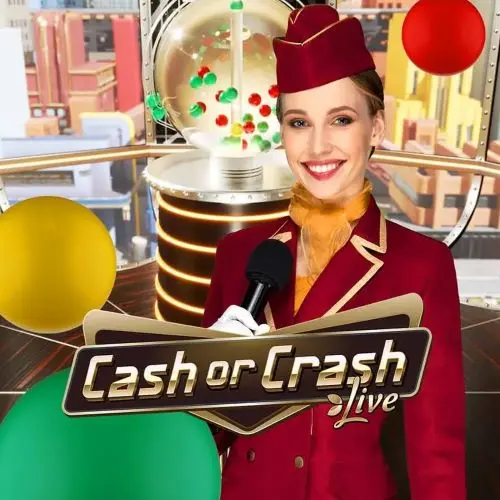
The game cash or crash live creates its own niche in the world of live game shows. Its appeal resides in a powerful blend of visual spectacle and game mechanics that turns every round into a personal test of nerve. This is not a passive spin of a roulette wheel. Here, you take the driver’s seat, actively deciding that influence your payout. The concept captivates you with a rising multiplier, then dares you to grab it before a hidden “crash” resets everything. To get the most out of the game, you must ignore the glitz and grasp its real function. Let’s analyze the rounds, the host’s function, the mathematics of risk, and the strategies players can use to manage the excitement.
The Primary Purpose and Fundamental Process
The aim of Cash or Crash Live is easy on the outside. You have to decide when to cash out a increasing multiplier before a secret “crash point” ends the game and removes your winnings for that phase. Every game starts with players placing bets. A rocket then launches its journey, and a multiplier commences increasing from 1x. The ride has multiple stages. Before launch, a hidden crash multiplier is set for each stage, concealed from all players. As the multiplier rises, players individually decides to hit “Cash Out,” locking in that multiplier on their wager, or to stay on board. If the rocket triggers the secret crash point prior to a player cashes out, they surrender their bet for that round. This pattern of danger and gain repeats over various stages. Those who endure accumulate their earnings gradually.
Dissecting the Stage Structure
Think of the game as a sequence of separate chapters, each a brand new risk. Avoiding a crash doesn’t eliminate you. You move to the following stage with your built-up winnings secure, then begin the risk process from scratch on the next leg of the rocket’s path. This setup is paramount. It generates a story, with pressure that intensifies as you advance. The presenter heightens the drama, revealing how many players are still riding the rocket as the multiplier hits scary levels. Initial phases often feature safe plays. Subsequent phases, with their high-stakes multipliers, entice you to gamble the gains you’ve previously won. This structure is the essence of the game’s drama. It forces a string of separate, critical decisions instead of only one.
From Low to High Risk: The Risk Escalation
Observe the colored trajectory the rocket travels. It’s a key part of the game’s language. The initial section is often a “Green Zone,” a less dangerous phase where a crash is still a possibility. Next, the rocket may enter an “Amber Zone,” a distinct indication that risk is rising. The concluding section is the “Red Zone.” In this zone, multipliers appear their best, but the likelihood of a crash is numerically at its maximum. Such visual cues are not merely decoration. They provide a immediate indicator for the hazard level at each instant. They turn an abstract probability become tangible. Knowing the game is purposely alerting you about growing volatility is a essential piece of game strategy.
Methodological Structures and User Behavior
No approach can overcome the fundamental randomness. But you can use structured methods to manage your money and your emotions. The key trade-off is a exchange. Do you guarantee assured gains, or pursue explosive profits? Users often employ techniques like the “Fixed Cash-Out.” With this approach, you choose ahead of time to settle at a specific multiplier, say 2x, in every stage. This aims for stable, small wins. The opposite is the “Let It Ride” style, where you risk multiple stages for a opportunity for a massive win, accepting that losses will occur. A more calculated approach is the “Percentage Bankroll” method, where you modify your stake based on your existing gains. The most important element, though, is in your mind. Can you resist the “greed factor” when the multiplier soars? Can you prevent annoyance after an early crash? Your best weapon is creating clear boundaries for yourself before the game even starts.
Typical Mistakes to Evade
Be wary of a few typical blunders. The most destructive is “chasing” a failure. This signifies rashly boosting your wager after a loss, which violates the game’s round-independent design. Another error is trusting the “hot hand” misconception, assuming a sequence of big payouts is expected to carry on. Allowing the presenter’s talk or the actions of other participants pull you away from your own predetermined strategy is common. Also, do not misunderstand the areas. The Amber and Red Zones are not obstacles to beat. They are warnings that the hazard has jumped. Starting any stage without a defined objective transforms the session from a series of choices into a sheer emotional ride. That journey rarely ends well.
The purpose of the live host and RNG
The presenter does more than talk. They determine the game’s emotional pace. While they cannot influence the result, they expertly build suspense. They announce the climbing multiplier and provide live updates on what percentage of the crowd is cashing out at each level. That social cue can play tricks on your head. But remember, the host operates independently of the game’s engine: the Random Number Generator (RNG). The crash point for each stage is established by a certified RNG the instant the stage begins. This ensures fairness and total unpredictability. The host has no clue when the crash will happen. Their job is entertainment. The RNG’s job is certifiable fairness. This combination blends transparent live action with provably random results.
Theoretical Basics and Volatility
Let’s look at the numbers that make the game tick. The multiplier for each stage is based on a set probability distribution. Common, lower multipliers like 1.2x or 1.5x are very likely to occur. Sky-high multipliers are possible, but they are exponentially less likely. This design ensures the game fair. The frequent, small crashes finance the infrequent, massive possible wins. The “Return to Player” (RTP) is a statistical percentage across millions of rounds. In a single gaming session, the variance are dramatic. You aren’t betting against the house in a conventional sense. You’re acting against a hidden, random number. Keep these key facts in mind:
- Independent Stages: Every round’s crash point is an independent occurrence. A 1.2x crash in the first stage does not predict the second.
- No Forecasting Ability: The random number generator ensures no predictable sequences. Previous crashes or large wins do not affect future rounds.
- House Advantage: The game is designed with an inherent house edge, as reflected in the publicly stated RTP from the developer.
Summary: A Blend of Chance and Choice
Cash or Crash Live is a fascinating fusion of absolute fortune and deliberate selection. Its mechanics are structured to weave a story of increasing risk, powered by a transparent RNG and brought to life by a charming emcee. Defining victory as a entertaining and likely lucrative game relies on a few things. It’s less concerned with anticipating the unpredictable and rather about comprehending how the game is designed. It requires handling your funds with discipline and controlling the emotional inclinations the game skillfully triggers. By studying its phases, respecting its statistical foundation, and sticking to a personal approach, you can transform your outlook. You go from puzzled speculation to knowledgeable participation in a exceptionally intense live game show.